
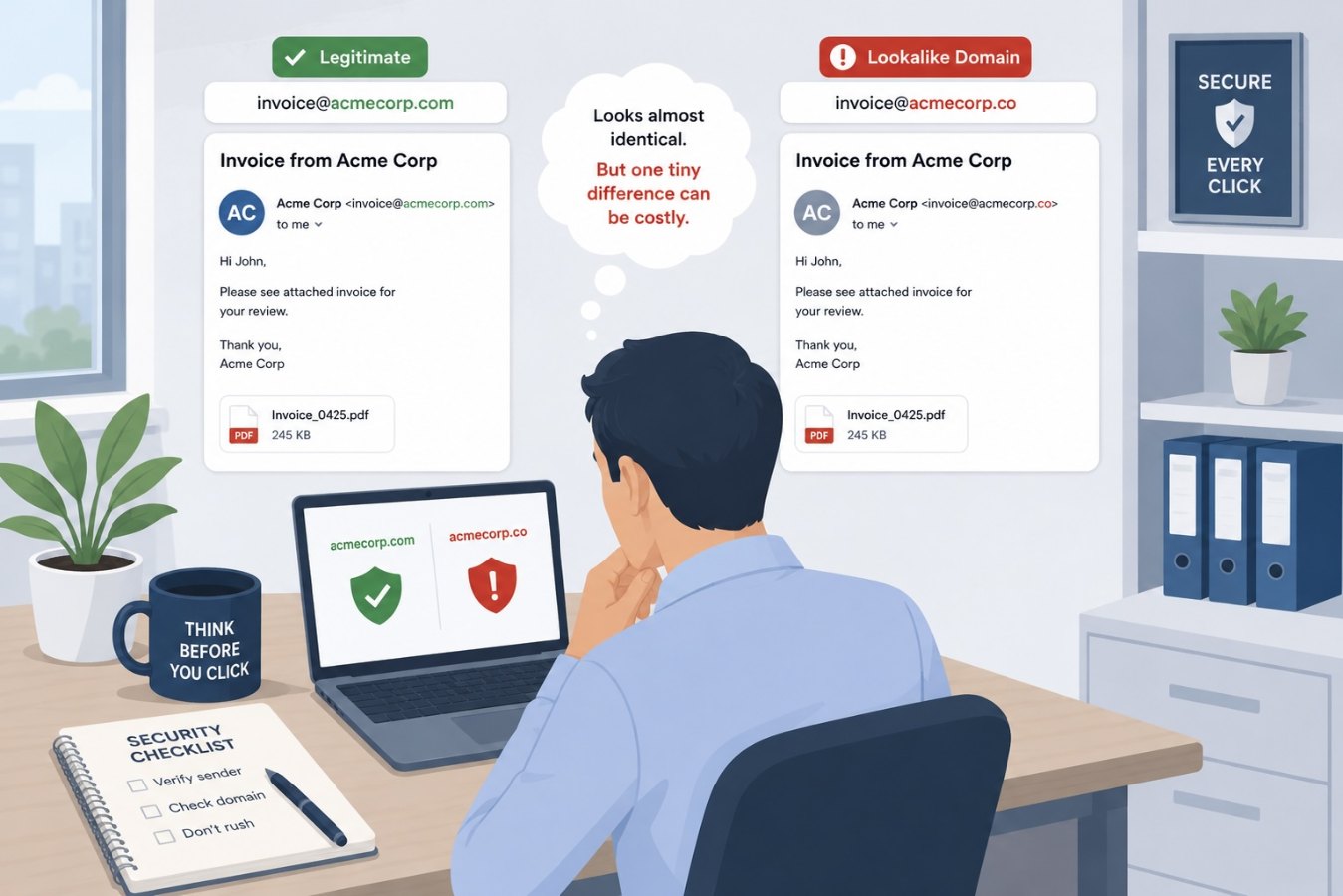
A familiar deception
Imagine your finance director receives an email from what appears to be your regular supplier. The message references an ongoing project and attaches an invoice for $25,000 with new wiring instructions. The email address is nearly identical to the supplier’s—perhaps `accounts@acme‑c0rp.com` instead of `accounts@acme‑corp.com`—and the domain uses a subtle character substitution that is easy to miss. The tone is professional and consistent with previous correspondence. Pressed for time, the director follows the instructions and wires the funds. It’s only days later that the real supplier calls about an unpaid invoice.
This scenario illustrates a typical lookalike domain attack. Criminals register a domain that differs by one or two characters from a legitimate company and use it to impersonate trusted contacts. Because the domain is new and controlled by the attacker, standard email security mechanisms such as DKIM or SPF cannot flag it as spoofed. According to law‑enforcement reports, BEC schemes often begin with spear‑phishing to gather information about roles, projects, and relationships inside a target organization. Attackers then time their fraudulent emails to coincide with real business activity, making the message more believable.
Why lookalike domains work
Several factors contribute to the success of lookalike domain scams:
- Human oversight: Busy employees may overlook a small difference in a domain name, especially if the rest of the email seems legitimate.
- Contextual relevance: Attackers do their homework. They reference real projects, use authentic signatures, and mimic writing styles to avoid raising suspicion.
- Sense of urgency: Fraudulent emails often convey urgency—claiming that payment is overdue or a contract will be canceled. This pressure discourages careful verification.
- Technical gaps: Standard email filters primarily detect known malicious domains or spoofed headers. A newly registered lookalike domain can evade these measures until someone manually blocks it.
Recognizing the signs
Employees can reduce the risk by learning to spot common indicators of a lookalike attack:
- Domain anomalies: Look for characters that substitute a number or letter (e.g., `rn` instead of `m`, `c0` instead of `co`, or .org instead of .gov). If in doubt, type the domain into a browser or search engine to verify its legitimacy.
- Unexpected payment requests: Treat any request to change payment methods or update banking details as suspicious. Always verify through a known phone number or existing communication channel before transferring funds.
- Mismatched reply addresses: Reply‑to addresses that differ from the sender’s domain or direct you to an unrelated domain are a warning sign.
- Subtle language differences: Attackers may not perfectly replicate tone and grammar. Watch for odd phrasing, unusual levels of urgency, or inconsistent formatting.
Building a defense
Protecting against lookalike domain fraud involves both technical and procedural measures:
- Implement strong email authentication: Use SPF, DKIM, and DMARC policies on your domains to prevent attackers from spoofing your company’s address and to improve detection of fraudulent emails.
- Monitor domain registrations: Use domain monitoring services or set up alerts for variations of your company name. Early detection allows you to block or take down malicious domains before they are used.
- Educate employees: Provide regular training on how to examine sender addresses carefully and verify financial requests. Encourage a culture where employees feel comfortable slowing down and double‑checking even urgent messages.
- Establish verification protocols: Require independent verification for changes to payment instructions or large financial transactions. A quick phone call to the known contact can prevent costly mistakes.
- Use multi‑factor authentication: Many BEC attacks begin with compromised accounts. Enforcing MFA across email and finance systems makes it harder for attackers to hijack internal communications.
Creating a culture of vigilance
Lookalike domain scams exploit human trust and the routine nature of business communications. They succeed not because of sophisticated malware, but because a single misspelled character goes unnoticed. By combining technical protections with careful processes and ongoing education, organizations can dramatically reduce the likelihood that a fraudulent email slips through the cracks.
The next time you receive a payment request or instructions from a familiar contact, take a moment to verify the details. A second glance at a domain name could be all that stands between your organization and a costly breach.